What began as an ordinary attempt to understand a sudden change in a young child’s behavior soon became a moment that transformed an entire family. Concerned by their toddler’s growing silence and hesitation, a mother decided to review footage from a small home camera. She expected to find clues, but nothing prepared her for what she would discover. The recording did not reveal dramatic arguments or obvious mistreatment. Instead, it captured something far quieter—and, in many ways, just as heartbreaking.
As the video played, a pattern slowly emerged. Their once cheerful daughter wandered into the room several times, looking toward her father with hopeful eyes. She smiled, held out toys, and lingered nearby as if waiting for an invitation to play. Yet each attempt ended the same way. Her father remained absorbed in his phone, barely noticing that she was there. Without a word being spoken, the little girl quietly stepped away, gradually learning that her efforts to connect would likely go unanswered.
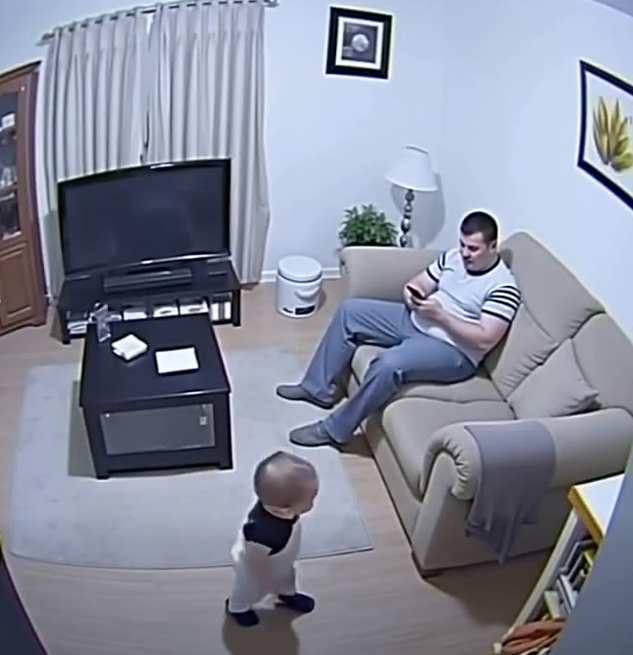
The mother watched every moment with growing concern. What stood out was not a single incident, but the repetition of the same interaction throughout the day. The child became increasingly cautious, pausing before approaching her father and appearing less confident each time. Experts often explain that young children build emotional security through consistent attention and responsive interactions. Even brief moments of connection can strengthen trust, while repeated emotional distance may slowly shape how a child understands relationships.
Rather than confronting her husband in anger, the mother chose a different approach. Later that evening, after their daughter had gone to sleep, she asked him to sit beside her at the kitchen table. Together, they watched the footage from beginning to end. At first, he remained silent, believing he had simply been relaxing after a long day. But as the scenes unfolded, he began noticing details he had completely missed in the moment.
He saw his daughter waiting patiently beside him. He noticed how often she searched for eye contact before quietly turning away. He watched her excitement fade each time she received no response. There were no harsh words, no visible conflict, and no dramatic confrontation. Yet the emotional distance was impossible to ignore. For the first time, he realized that being physically present was not the same as being emotionally available.
The experience proved deeply emotional for both parents. The father admitted that work-related stress and constant digital distractions had gradually consumed more of his attention than he had realized. He had convinced himself that simply being home meant he was spending time with his family. The recording challenged that assumption, revealing how easily important moments had slipped away unnoticed.
Family counselors frequently point out that technology itself is not the problem. Smartphones, tablets, and computers are valuable tools in everyday life. The challenge arises when digital distractions repeatedly interrupt face-to-face interactions, especially with young children who depend on responsive communication to feel secure. Simple actions such as making eye contact, answering questions, and sharing a few uninterrupted minutes of play can have a lasting impact on a child’s emotional development.
Determined to make changes, the couple agreed to establish new family routines. Phones would be set aside during meals, bedtime, and dedicated family time. Evenings became opportunities for reading stories, building toys together, and having conversations without digital interruptions. At first, the changes felt unfamiliar, but they gradually became part of everyday life.
Over the following weeks, they noticed encouraging signs. Their daughter began smiling more often, approaching both parents with greater confidence, and inviting them to play without hesitation. The small moments of laughter that had once become rare slowly returned. While rebuilding trust required patience, every shared activity strengthened the bond that had begun to weaken.
The couple also decided to attend family counseling, viewing it not as a sign of failure but as an investment in their future together. The sessions helped them communicate more openly about stress, parenting responsibilities, and the challenges of balancing work with family life. They learned practical strategies for remaining emotionally present, even during busy or difficult days.
Child development specialists emphasize that no parent is perfect. Every family experiences periods of exhaustion, distraction, and uncertainty. What matters most is the willingness to recognize problems early, accept responsibility, and make meaningful changes. Children are remarkably resilient when they consistently experience love, attention, and reassurance from the people they trust most.
Looking back, the mother says the hidden camera did far more than answer her questions. It revealed everyday moments that had quietly shaped their daughter’s emotional world without anyone realizing it. The footage became a turning point—not because it exposed dramatic wrongdoing, but because it encouraged honest reflection and meaningful change.
Today, the family continues working toward healthier habits one day at a time. Their story serves as a reminder that the strongest parent-child connections are often built through ordinary moments of attention, conversation, and shared experiences. Sometimes the most important message a child receives is not spoken aloud at all—it is communicated through eye contact, presence, and the simple reassurance that someone is truly there to listen.